Tell us about the job
Takes about a minute. No obligation.
A contractor quoting a water heater install in Clinton County has to account for what the local climate actually demands before settling on equipment or placement. 186 severe weather events were recorded in Clinton County, Ohio between 2015 and 2024. At that rate, severe weather is a standing condition here, and a water heater that runs against it year after year faces a different operating reality than one in a quieter part of the country. Sizing, the quality of connections, and where the unit sits in the home all carry more weight because the stress on the system is real and recurring.
The electrical panel in a typical Clinton County house was sized for what people plugged in back then, and a new water heater often draws more than that original service was laid out to carry. Half the homes in Clinton County, Ohio were built in 1977 or earlier (2020-2024 ACS 5-year). That means a contractor quoting a water heater installation here has to assess the electrical first. If the panel falls short, the equipment quote becomes secondary to an upgrade the homeowner did not expect.
The Parts of a Water Heater an Installation Covers
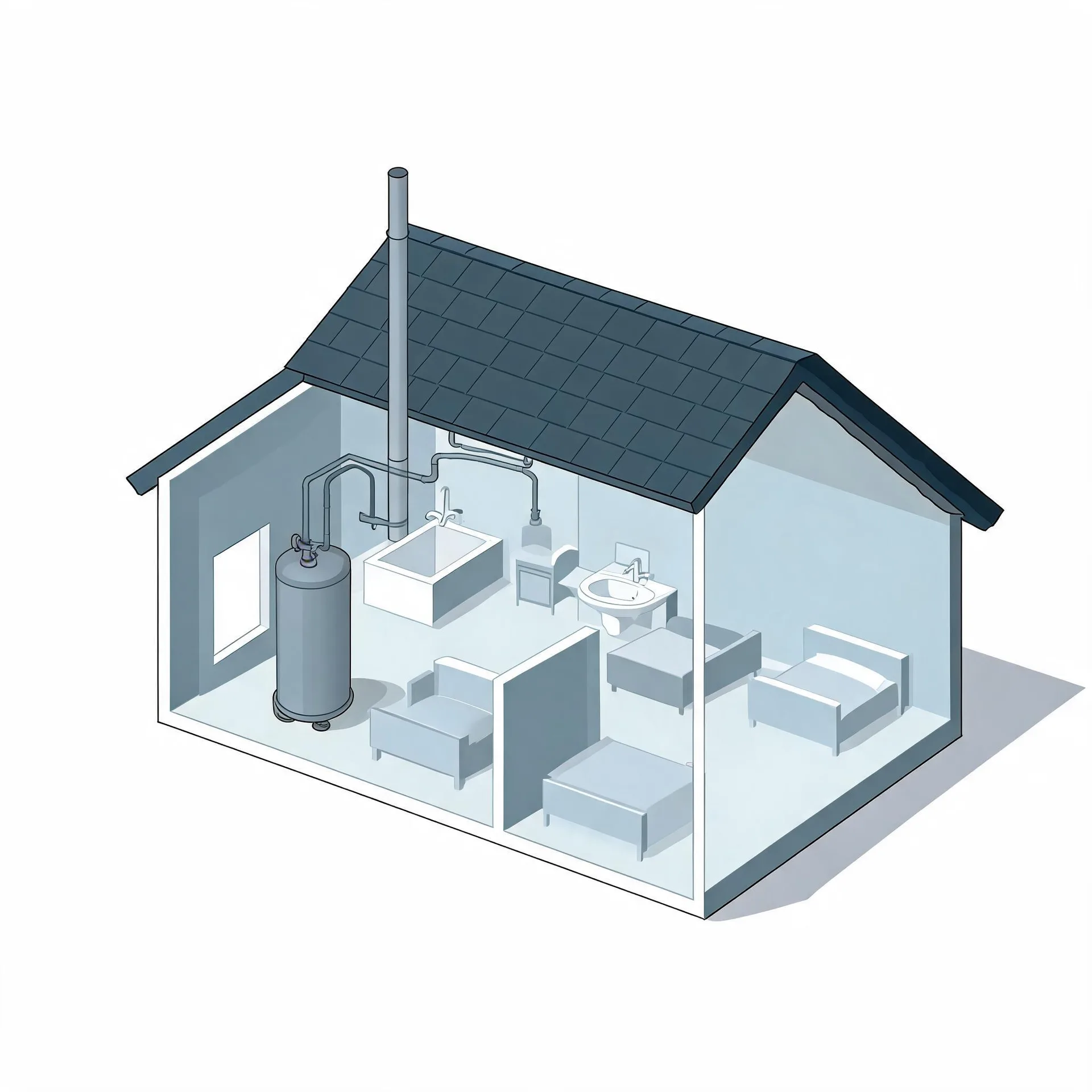
The tank is the centerpiece of the system, sitting in a utility room, basement, or closet, and its job is to hold and heat a supply of water ready for use throughout the house. The dip tube runs into the tank and directs cold incoming water to the bottom, while the heat source, whether a burner assembly or electric heating elements, applies heat from below or within.
A pressure relief valve mounts on the side of the tank and opens automatically if internal pressure climbs beyond a safe point. The anode rod hangs inside the tank to slow corrosion of the tank walls, and the flue or exhaust pipe exits through the top on gas-fired units, carrying combustion gases out of the living space.
The drawing shows a general layout of these components, and a licensed contractor determines what applies to the setup in your home.
Get matched in Clinton CountyClinton County, Ohio, by the numbers
186 severe weather events were recorded in Clinton County, Ohio between 2015 and 2024.
NOAA National Centers for Environmental Information, Storm Events Database, bulk CSV export, events 2015-01-01 through 2024-12-31.Half the homes in Clinton County, Ohio were built in 1977 or earlier (2020-2024 ACS 5-year).
U.S. Census Bureau, 2020-2024 American Community Survey 5-Year EstimatesClinton County, Ohio holds 18,039 housing units (2020-2024 ACS 5-year).
U.S. Census Bureau, 2020-2024 American Community Survey 5-Year EstimatesOwners occupy 71.8% of the occupied homes in Clinton County, Ohio (2020-2024 ACS 5-year).
U.S. Census Bureau, 2020-2024 American Community Survey 5-Year EstimatesRules & Standards Governing Water Heater Installation in Clinton County, Ohio14 sourced rules and standards
Licensing and Legal Requirements in Clinton County, Ohio
An Ohio home construction services contract must include a copy of the supplier's certificate of insurance showing general liability coverage of not less than two hundred fifty thousand dollars.
In Ohio a home construction service means the construction of a residential building, including the repair, improvement, remodel or renovation of an existing structure, and does not include construction on a structure containing four or more dwelling units except for work on an individual dwelling unit within it.
A home construction service supplier in Ohio is defined as a person who contracts with an owner to provide home construction services for compensation and who maintains a general liability insurance policy of not less than two hundred fifty thousand dollars.
The Ohio construction industry licensing board issues state licenses to individuals as heating, ventilating and air conditioning contractors, refrigeration contractors, electrical contractors, plumbing contractors and hydronics contractors.
An Ohio board of county commissioners may accept a valid and unexpired Chapter 4740 license held by a heating, ventilating and air conditioning contractor toward its own licensing requirements for work on one-, two-, or three-family dwelling houses.
An Ohio board of county commissioners may adopt rules licensing heating, ventilating and air conditioning contractors who are not required to hold a state license under Chapter 4740.
In Ohio municipal law a specialty contractor includes heating, ventilating and air conditioning contractors, refrigeration contractors, electrical contractors, plumbing contractors and hydronics contractors.
An Ohio board of county commissioners may not register a specialty contractor who is required to hold a license under Chapter 4740 but does not hold a valid one.
An Ohio municipal corporation may not register a specialty contractor who is required to hold a license under Chapter 4740 but does not hold a valid one.
In Ohio building law a residential building means a one-family, two-family or three-family dwelling house and any accessory structure incidental to it, and does not include an industrialized unit, a manufactured home or a mobile home.
Ohio's contractor licensing chapter reaches only work on a construction project, and a construction project is defined to exclude residential buildings, so an HVAC contractor working on a one-, two-, or three-family dwelling in Ohio falls outside the state licensing requirement.
Violating Ohio's contractor licensing prohibition is a minor misdemeanor on a first violation and a misdemeanor of the fourth degree on subsequent violations.
Under Ohio law no person may act as or claim to be a type of contractor that Chapter 4740 licenses unless that person holds a license issued under that chapter.
In Ohio a home construction service supplier may not perform a home construction service costing twenty-five thousand dollars or more without entering into a written home construction services contract with the owner, unless the supplier and owner enter into a cost-plus contract.
Severe Weather Events in Clinton County
Water heaters work harder when outdoor conditions swing hard, and in Clinton County that workload is shaped by local weather patterns specific to this part of Ohio. Knowing what the climate asks of equipment here is part of sizing and installing a water heater that holds up.
186 severe weather events, 2015–2024. Source: NOAA National Centers for Environmental Information, Storm Events Database.